
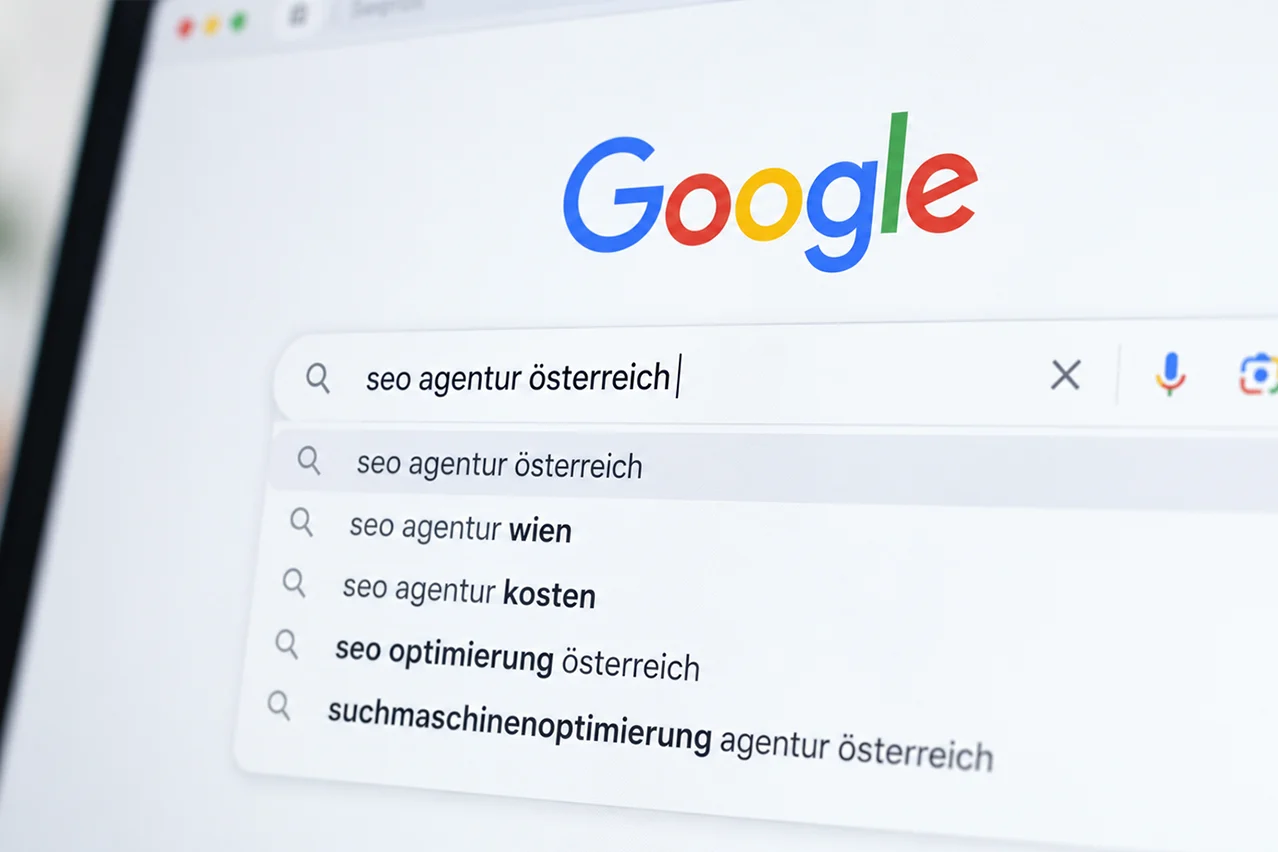
A professional SEO agency in Austria should do much more than simply add keywords to existing texts or adjust a few meta titles. Modern search engine optimisation combines technical quality, content, information architecture, internal linking, user experience, local visibility, data analysis and increasingly also visibility in AI-powered search systems.
Businesses searching for an SEO Agency Austria therefore often face a fundamental question: Which services actually matter, which measures create long-term value and how can you tell whether an SEO provider works strategically and transparently?
What Does an SEO Agency Do?
An SEO agency helps businesses improve the visibility of their website for relevant search queries.
The objective is not simply to generate as many Google visitors as possible. Successful SEO attracts the right users through search terms that match the company's actual services, products and search intent.
Professional SEO therefore does not begin with a single keyword. It starts with an analysis of the website, market, competitors, target audience, search intent and technical environment.
SEO Agency Austria: Why the Austrian Market Requires Its Own Strategy
Depending on the industry, Austrian businesses compete with local, national and international providers.
Search behaviour, terminology and regional intent can also differ between Austria, Germany and Switzerland.
SEO for the Austrian market should therefore not simply copy a German keyword strategy. Search terms, search volume, local queries, locations and user expectations should be analysed specifically for the Austrian market.
This is particularly important for local searches combined with cities and regions such as Vienna, Graz, Linz, Salzburg, Lower Austria or other Austrian locations.
1. Keyword Research as the Foundation of an SEO Strategy
Professional keyword research identifies what potential customers are actually searching for.
The keyword with the highest search volume is not automatically the best keyword for a business.
Search intent, competition, keyword difficulty, commercial relevance and the question of which specific page should rank for each keyword are equally important.
It is also important to prevent several pages from targeting exactly the same search term without a clear purpose.
This is often referred to as keyword cannibalisation. It can make it more difficult for search engines to understand which URL should rank for a particular topic.
2. Technical SEO
Even excellent content may fail to reach its full potential if search engines cannot crawl, understand or index a website correctly.
An SEO agency should therefore review factors such as indexability, HTTP status codes, canonical tags, redirects, internal linking, XML sitemaps, robots.txt, structured data and international versions.
For multilingual websites, correct hreflang implementation can also be important.
Websites with separate content for Austria, Germany and Switzerland should clearly communicate which language and country version is intended for each audience.
3. Website Structure & Information Architecture
Search engines need to understand which topics a website covers and how individual pages relate to each other.
A logical structure consisting of categories, service pages, subpages and supporting blog articles helps both search engines and users navigate the website.
A central service page can cover a broader topic, while specialised subpages explain individual services in greater detail.
Blog articles can answer informational search queries and link users naturally to relevant services.
4. On-Page SEO
On-page SEO includes all optimisation measures carried out directly on the website.
These include page titles, meta descriptions, heading structures, content, images, alt text, internal links, URL structures and semantic markup.
Keywords should not simply be repeated as often as possible. Content should first and foremost be clear and useful for users, while still making the main topic of the page obvious to search engines.
5. SEO Content That Actually Helps Users
SEO content should answer a specific search intent as completely and clearly as possible.
Good content explains a topic, structures information, answers common questions and links to relevant additional resources.
Keyword-heavy content without genuine informational value is not a sustainable SEO strategy.
A strong website therefore usually combines commercial service pages with informative articles that address users at different stages of the decision-making process.
6. Internal Linking
Internal links help search engines understand the relationship between different topics and pages.
They also guide visitors towards useful additional information and relevant services.
An SEO article can, for example, link to related services around websites, landing pages, web hosting or technical development.
Learn more about professional websites at Websites & Landing Pages by IKUNIX .
7. Local SEO for Businesses in Austria
Local SEO is particularly important for companies that serve customers in specific cities or regions.
Important elements include location information, location-specific landing pages, a properly maintained Google Business Profile and consistent company information across relevant platforms.
An SEO agency in Austria should determine whether users search nationwide or primarily within specific regions.
A business focusing on Vienna may require a different keyword strategy from a company targeting customers across all of Austria.
8. Website Speed & Technical Performance
Website performance affects both user experience and the technical quality of a website.
Large images, unnecessary JavaScript, insufficient caching or slow server infrastructure can significantly increase loading times.
An SEO analysis should therefore also consider performance metrics and Core Web Vitals.
Hosting can play an important role as well. Learn more about our IKUNIX Web Hosting.
9. SEO and Conversion Optimisation Belong Together
Good rankings alone do not automatically generate enquiries or revenue.
Once users reach a website, they still need to understand the offer and be guided towards the next relevant action.
Clear calls to action, understandable service descriptions, contact options and logical page structures are therefore just as important as search visibility.
For targeted campaigns, a dedicated landing page may be more effective than sending traffic to a general service page.
For more advanced projects, IKUNIX also develops Advanced Landing Pages .
10. Tracking & Measuring SEO Performance
Professional SEO should be measurable.
Tools such as Google Search Console, Google Analytics, Google Tag Manager and additional analytics platforms can be used to understand performance.
Rankings are only one metric. Organic clicks, impressions, landing pages, conversion rates, enquiries and qualified leads may be considerably more important from a business perspective.
A good SEO agency should therefore define which KPIs actually matter before evaluating campaign success.
11. SEO for AI Search & Generative Search Systems
Traditional web search is increasingly being complemented by AI-powered search results and generative answer systems.
This means SEO now also involves the question of whether content can be clearly understood, attributed and potentially used as a source by AI systems.
Clear structure, identifiable entities, technical accessibility, subject depth and reliable sourcing are therefore becoming increasingly important.
We explain this topic in greater detail in our article: Generative Engine Optimization (GEO): How to Optimise Websites for AI Search .
12. SEO & Structured Data
Structured data can provide search engines with additional machine-readable information about businesses, services, products, articles or frequently asked questions.
Depending on the page type, different Schema.org types may be appropriate.
Structured data does not replace high-quality content. It complements a technically and semantically well-structured website.
13. SEO During a Website Relaunch
A website relaunch is one of the situations where SEO should be considered from the very beginning.
If URLs are changed or removed without considering existing rankings, backlinks and redirects, organic visibility can be lost.
Before a relaunch, existing URLs, rankings, internal links, redirects and indexed pages should therefore be documented.
How Much Does an SEO Agency in Austria Cost?
SEO costs depend heavily on the actual project.
A small local business website requires a different level of work from a large online shop, multilingual company website or technically complex platform.
Relevant factors include the size of the website, its technical condition, competition, number of relevant topics, required content and the desired level of ongoing support.
Professional search engine optimisation should therefore not be priced purely according to the number of keywords being tracked.
One-Off SEO Optimisation or Ongoing SEO Support?
Both approaches can be useful depending on the situation.
A technical SEO audit or one-off optimisation may be appropriate when fundamental technical and structural problems first need to be resolved.
In competitive industries, ongoing optimisation is often more appropriate. New content, changes in search results, competitors and technical developments continuously create new optimisation opportunities.
How Can You Recognise a Good SEO Agency?
A professional SEO agency should be able to explain what is being done and why a specific measure is relevant.
- transparent keyword and competitor research
- technical website analysis
- clear prioritisation of recommended measures
- realistic expectations instead of ranking guarantees
- transparent performance measurement
- coordination between SEO, development and content
- focus on actual business objectives
- clear documentation of implemented measures
Be Careful with Guaranteed Google Rankings
Claims such as “guaranteed number one ranking on Google” should be treated with caution.
Search rankings depend on many factors and cannot be responsibly guaranteed.
A professional agency should instead explain which improvements are realistic, which measures will be implemented and how results will subsequently be measured.
SEO Agency or Do SEO Yourself?
Businesses can implement many basic SEO measures themselves.
Examples include clear page titles, useful content, internal linking and maintaining a Google Business Profile.
SEO becomes considerably more complex when technical errors, large websites, multiple language versions, redirects, structured data or extensive keyword strategies are involved.
Combining SEO, Web Development & Technology
SEO projects often become inefficient when analysis and technical implementation are completely separated.
If an SEO audit identifies problems with URL structures, templates, structured data or internal linking, development work is usually required to implement the solution.
At IKUNIX, we therefore combine web development, SEO, tracking and technical optimisation.
For custom integrations and technical extensions, learn more about Interfaces & Custom Development .
How Does Professional SEO Optimisation Work?
The process usually starts with an analysis of the existing website and its current organic visibility.
Relevant search terms, competitors and technical issues are then evaluated.
Based on this analysis, measures can be prioritised according to their expected impact.
Technical problems with significant SEO consequences should not be delayed in favour of purely cosmetic optimisations.
After implementation, rankings, organic traffic, clicks and relevant conversions should be monitored continuously.
SEO Agency Austria: Conclusion
A good SEO agency in Austria should combine technical, content-based and strategic search engine optimisation.
The objective is not to place as many keywords as possible, but to ensure that a website reliably covers relevant search queries, works technically and guides users towards meaningful actions.
This includes keyword research, technical SEO, information architecture, useful content, internal linking, Local SEO, website performance, tracking and increasingly optimisation for AI-powered search systems.
Businesses that want sustainable SEO results should therefore evaluate their website as one connected system consisting of technology, content, user experience and measurable performance.